old friends

They could have been together paddling north on Lake Champlain or crossed on foot through the Blue Ridge “Gap;” followed on the heels of Lewis and Clark or pitched a tent on the Brazos. They would have been at home with John Jacob Astor, trapping the Northwest. Traders, they would have been comfortable at Bent’s Fort, isolated in southeastern Colorado, exposed to dangers East and West. Fremont would have gladly taken them on his expeditions of glory.

Shotguns or long guns would have accompanied them and proficiency would be a given; given as in physical ability followed by determined and repetitious practice. Neither would have shirked from becoming better than good.

As individuals they were comfortable with themselves but with each they held friendship close. They were not loners. They worked the nuances of life with but a few to surround them, choosing to fight their own demons should they surface. All was played out beginning in 1951, when they found themselves living in close proximity and quietly saw the other in the same wood lot. They bonded and from there they played out their own sense of history.
Youthful fantasies moved to real time adventure and no small animal was truly safe from their bb guns, 22’s, and knives. They lived in the fields, lowlands and woods crafting skills that predominated their DNA. School brought some unforeseen gratification, namly girls and sports, but it also pricked their given nature to learn. They took to all three, with their own set of rules crafted from the youth of “the field.”

One found his woman early and presented to her a “teepee” of their own to start out in the real world. The other, taking a different direction with education, fought against any ties, or more to the fact dismissed them out of hand. They had been together in the Parochial school, separating in grade eight. Two years separated them in age and when the elder one moved to the suburbs his family kept him in private school. He excelled and found dentistry to be his call. The younger “pushed” his way through school and he and his young bride began their lives living on their wits, their strong work ethic and, he, his fortitude and drive. A bill collector, many times he would be found sitting on the steps of a “client” waiting to meet them face to face to secure the outstanding funds. His direct manner proved successful. His drive kept him accelerating professionally.

Friendships are easily contorted to be summarized as hard wood connections, but in truth that only comes in the strength of family and if lucky a friend. What began in the fields of their childhood was like particle board in its composition of friendship. Thick board, hard to cut through and chip away. Theirs was a mutual complexity of competitive drive, physical exertion and purposed living. They loved the hunt and found the woods an hour or so north worthy of this pursuit. A hunt would include Irish Setters, sandwiches washed down with water and a “walk” from early day to dark. Limits of birds were usual. Gratification flowed over tired limbs.

Midlife found them out West where they fell in love with the prairie and mountains, hunting antelope, deer and elk. Years flowed together to provide icing to this love of the outdoors and they respected each animal hunted. Success was not measured completely by the harvest, but it was the measuring stick of the hunt. The tales were fruitful in their telling.

It was not by chance that the game that captured each was golf. There, the love of competition and the outdoors converged to give both the adventure in tranquility, a pursuit of excellence and grafted into them purpose to excel. Each reached the maximum of their skill qualities and then eked out a little more. Beating them was not an odds favored “take on.” Seemingly twenty foot putts would be drained when needed to take a hole. The “to live” attribute, where you had to “beat” the other to survive summarized their progressive natures. Survival was real to each. They played different styles, but the results were conclusively the same. They won. Though they tended to court courses separate from one another, they on occasion fronted the same one and the magic of trying to beat the other with supreme intensity while maintaining the decorum of friendship was admirable to say the least.

Where they trumped others on any given day or night and in an inebriated condition or cold sober, was in the game frequently played at many 19th watering holes, Gin. As single players they did fine. But as partners they were killers. And they would beat their opponents on a last card draw and crush spirits. There was just an innate sense, perhaps gathered from the woods of youth, that seemingly brought victory at the conclusion of the night. In the cabin of mid-life, they “smoked” all comers while Jack Daniels or a cold beer or three loosened the day.

The juggernaut of time came and trimmed their sails. The games became infrequent and the gatherings more so. The aging snuck in and toiled their bodies with injuries and health; those frustrating irritants of living. The families of each now became the focus of contact, yet they enjoyed the banter when functions drew them together. A wake or funeral it seemed. The past had more of a lure to them but it did not smear them with nostalgia. If anything, it protected their souls from the onslaught of aging. They rightfully could say they had lived full. The last act was in mid scene and they knew the curtain could be closed any time.

Daily functions of activity provided knew areas of conquest and given their nature to proceed with what they had available, they strived to make each day a go. They were loved and this meant a great deal to each. Knowing that they had touched upon the great mystery of connecting with a woman who stood by them and children who gave them respectful and caring love with a banter of mirth and an essence of charm pleased each. They chose to interact with those closest to them, the family. Who better to give to? And this played to their accomplishment of connectivity. They had love to give which adhered to personality. They held to who they were and what they could continue to accomplish.

Hunting weapons were exchanged for shop tools or walking canes. Best said is each took the daily opportunity of living and rode it. It was a long way from those woods. The bond, stretched and squiggled here and there was in place. The sunset had come. It’s yellow glow was nice. The handshake first made remained firm and sincere. The friendship had endured. For this a certain gratefulness swathed each. It was good.

Posted in Uncategorized | Leave a comment

Oct. 14, 1919

Happy Birthday Dad.

It has been awhile.  Have not stopped out to your beautiful park in more than a year. Strange how, when I stopped the last time, your name had become almost impossible to read where Cindy’s was still the same and she has been there for 51 years.  I expect it is probably a combination of two things;  the “Greatest Generation” is coming home more frequently and markers are made in China!!  I would say something, but It does not matter to me.  I know it is you.

Mom said her final “hello” to you, physically, a few years ago.  She is good with her memories and has the picture with the wreath standing between you and Cindy from a few Christmas’ ago.  You would be proud of Mom.  She has lived well, Dad.  She has kept that pixy spirit that you fell in love with back at Grinnell!  She has been there, as you always were, in her indomitable way, for any and all.   The Pebble to your Rock she has maintained.

The Rock.   Gregg spoke of this monocure produced from your consistent flow of tough but thoughtful will.  I can still see you placing your elbow on the table, fist clenched, posed as a decompressed “Thinker.”  You said it first, but then we all took it as the name that formulated your essence and therefore stood with it in such a way that comfort could not but be found.  You are our Rock, our steady helmsman in life; lives no different than others in relationship to the fact that we all have experiences that unsettle or perplex us. We just “know” that you are with us, no matter where we were, that your strength of character provided our platform to soldier on, or better yet, “pilot” on.  You absolutely, sometimes to our irritation, maintained a discipline of absolutes that has secured a foundation that we fall back on time and time again.  Dad, you are such a backstop, a chainlink fence of titanium that has always protected.  But how could such strength be so supple?  Such character forged from within and expressed outwardly is rare.

You went to war, becoming an aviator for many reasons but the one that stays with me to this day, Dad, is that if you were to “get it” you did not want to come back maimed or in any way a hindrance to anyone; that you chose that which would give you death as the greater possibility.  I still cannot fathom the thought process you entertained then.  But I so love it.

And it was in war that you proved your companionship, your “salt”  not only as a flyer but as one that could be trusted.  It is why you were so desired as a wingman.  And you never gave up.  Three flying crosses later, two of them for being there for your fellow aviators in trouble speaks highly of what a man you are.  I always held that close to me when I would sit at the nursing home with you.  I know I did not stay long, but just coming to see you, making the drive, was something that filled me.  You never left me Dad.  I know you were “gone,” but never in my eyes.  The letter to Mom from one of your last flying “partners” merits reflection, when he said you were the one who would volunteer to fly cover in the worst conditions so others would not have to.  He said you were the best.

Your dedication to your company, thirty plus years, and then they threw you under the bus.  Yet, you never complained nor said a mailaced word.  You found a home with United Way and when you tried to clean some of the slop there they asked you to leave. So you did.  I don’t think you looked over your shoulder either!  Your secretary of many years said that she never met a more nice, accountable and hard working man.  I know it was hard to leave Mom with the five of us( six for a few years) but you did what you needed to do.  You always came home.

You were never Pops to me.  Father once in a while but always Dad.  You had such respect from so many people.  Did I ever say how much I respected you Dad??!  I know I have told many people that I had one hero growing up, and that was my Dad. Funny how, looking back 63 years, how true that is.  You are a hero to me.

The greatest poem I have ever read was the one you wrote the day after Cindy died.   I have never read something so simple yet so deep in its love.   But what cornered me most was, hidden in the texture of the verses, the gratitude for which you were thankful you had her for her six years.  And they were hard years!!

I only saw you cry once; when the U.S. won the hockey gold medal at the 1980 Olympics. It was not about the win.  I knew that.   It was about Jim Craig, the American Flag ( the Flag you flew for and worked for) draped around his shoulders, skating around looking for his father.  “Where’s my father??”  Yes, it truly was the first time I saw you cry.  Not blubbery mind you, but manly.  I feel choked thinking on it now.

Dad, you said to me years before I found Amy that you would not want to be raising children as my generation was hard at work doing just that.   How insightful you were.  Oh, its not that it is not ‘good,’  its just that you saw, honestly, the melting of the middle class. This is what our country can honestly hold itself above when comparing the great societies of History, the making of the great middle class. That is what your generation was about. Perhaps Brokaw said that in his book or alluded to it, I cannot remember.  But it is this foundational element that we introduced to the world as the standard that made and gave equality a chance.  It  developed such stalwart personage and greatness of value.  I can’t stop the melting, Dad, but I won’t stop trying. Because you would never would.

I love you Dad.  Happy Birthday.

Douglas Armin Werlein

Posted in Uncategorized | 1 Comment

the last dance

The room smelled old, powdered with the nausea ammonia smell that flavors sweat drenched clothing. Hard, pressurized water made hissing sounds in the adjacent room. Naked bodies entered, slowly. Not many were exiting. The carpeted red floor was adorned with wet items in disheveled clumps. Jerseys, pants, stockings, long underwear (arms and legs cut off,) shoulder pads, shin pads – socks, cups…. Most were in one or two piles.

He sat there, still undressed, arms resting on his thighs, hands unclasped. His head was bowed slightly. His eyes were fixated, but sightless. His mind had disengaged from them. The only connection between the two had brought misting. Now the “distance” had dried them. He was “alone.”

The recollections began in slow motion with no real semblance of order. They plugged themselves into his consciousness randomly. He had no control nor desired any. They filled as if an epiphytic kaleidoscope. He was softly falling back in time. The one constant was his non-existence in the room, his team’s room; the team which had just finished its last game of the season and for him the last game of his career. The “music” had stopped.

He had become a piece of a team when he was in sixth grade. It was the first year where the score mattered. Dad was sitting on the edge of the bed. He laid on his back, hands folded behind his head. He was supposed to be resting, but his mind rattled with random waves of queries. He was the goalie and the team was playing for first place against St. Marys, the parochial school which constituted the majority of the town’s better players. They lost 2-0. One of the goals allowed bounced off the wood post of the net. The goal judge stood on the bracing at the back of the net. He called it good as it hit the inside of the post. No one but him protested. No one listened. Tears formed behind his cage mask. He never played goalie again.

The Refs had taken a dislike to their team’s style of play. He was a senior, and they were pre season favorites not only to win the league but to perhaps make a run at the State Championship. Infighting with younger players had suffocated the oxygen from the team and they were stumbling to a third place tie. Frustration had perspired from the group and the play followed. The penalties began adding up. Already known for toughness, cheapness squeaked in and the finesse began to fizzle. The semi-final loss in the Regionals to the team they had conquered twice was a proper ending, but felt crappy. He had made a rush with time winding down but was denied at the crease. He was unaware of the Refs whistles as he hacked at the glove smothering the puck. He spent the last ten minutes of the game in the penalty box for misconduct.

The magic began just after the new year, his junior year in college. They were a mixed bag of thoroughbreds who were being harnessed to a style of play that was better managed to pull a wagon than thunder the Track. In January they began to spill out individually into their youthful ways where they had learned to play on the frozen lakes, with no rules or boards. As one took off another followed and the surge could not be suppressed. An idiot would have wanted to. They blew away the competition as they pushed hard to shake mediocrity and become not just good but great. His role was to make sure the racers did not succumb to any thuggery along the way. The end was a game where dominance of play did not coincide with a win. No blame was attached, just a sucking feeling. The bus ride home was quiet. He left school a week later.

Undrafted, he sought a tryout with the Oakland Seals of the United States Hockey League. It was the ugly cousin of the NHL trying to win the prom queen, the fan base. He was quarantined to Hershey. Oakland had dismissed him outright and as he sought playing time somewhere, the Hershey Bears needed some knuckle power and asked him to come on board. The year was a blur of bus rides, beer, girls, blood and laughs. He began to soak his hands in ice after games when the pain was piercing. Then a teammate suggested soaking them in ice before the games to harden the skin. So the practise of icing before and after became natural. His knuckles could cut skin like a hot knife on butter, even flattened as they were.

As often as he was jettisoned from teams, he found footing in another city. He would become a crowd pleaser as the Colosseum always loved blood. And he brought blood, either his own, another’s, or both. Yet the act would begin to suffocate the life from his soul and he would try to escape to his roots, out there on the pond. Where he could skate, free. It was not what was wanted. He would be packing his bags by the end of a season.

He sat there with these and other random thoughts slamming about. There were those crazy times remembering his father telling he and his brother about sitting on the bumper of his grandfather’s Ford hunting pheasants. They would drive around the dirt roads adjacent to fields. The birds were as numerous as carrier pigeon in prime time. Limits were as many as you killed!

His brother brought a case of Schmidt’s and they tried their own version of that old fashion hunting. They “exchanged” the Ford for a Chevy truck and the tailgate for the bumpers. They took turns driving the gravel and shot at anything that moved, in the air or otherwise. They were lucky. No broken bones and the shot did not carry far enough to bring collateral damage, at least they did not think it had. One rabbit was their tally, but so many laughs.

He slowly reclined to rest his back in the locker. Not a piece of equipment sans helmet and gloves had been removed. He did not remember removing the helmet and the gloves had slid off his hands as he sat down. His jersey stiffened as it dried, unmolested as one memory benched another. A body approached and sat down next to him. A can of beer was set by his left thigh.

“Tommy, bottoms,” and the new neighbor took a long pull on his own beer.

“Thanks Larkie.” It was a sport that endeared itself to intimacy by equating a “y” at the end of a name. like the Goodfellas and their “forget about it.” A staple of vocabulary that functioned to establish membership. Dougie, Tommie, Bobbie, Frankie, Tootsie…. When you wanted to intimate, you placed the “e” sound on the end.

“Canfield?”

“Yeah?”

You thinking?

He smiled. Only Larkin, a Harvard man, would say that. And bring a beer to him.

“Yeah, caught me I guess.”

Larkin drank again. “Let me guess, not about the game or the show you put on.”

“Right, just stuff.” Only Larkin would have said this.

“Larkie, this is it.”

Larkin knew what was going on. He had known Tommie for just about two years, when Canfield had first come to the team, mid-year two seasons ago. Larkin had winced when he first heard the news. Now, he was fond of him. He did not really have a friend on the team, many teammates, but not a real friend. Tommie intrigued him.

‘You want to talk?”

Tom Canfield sat quietly. He turned his head slightly to see Larkin, the first time he had focused on anything. “Lark, you good?”

“Yeah, I am. Me and Plato got it covered.”

“None of the classic crap.”

“No, just covering is all.”

“What?”

“I’m saying bottoms to you Tommy. Its good. Its fine. You did good, real good, real fine. I think,” he paused and took a long pull of his beer, tilted his head down and belched. “I believe you are a good person and a good hockey player.”

Tommy looked in Larkin’s eyes. They were sincere.

“Thanks.”

“Tom, you have played the game, and the game within the game, for, what, eight years at this level? And you have never shoved it back on anyone. You packed up when they said to, you moved in where you could, took the ice when and where you were asked and gave what you could and what they wanted. But you need to know that you are a good player, beyond being a good teammate. Beyond ‘the game.'”

“You Ivies talk too much!”

“Yeah, well that is what we are supposed to do.”

“Talk?”

Larkin let out a light laugh. ‘Pretend, and own the world someday!”

Tommie smiled. He had not touched the beer yet.

“You going to drink that beer?”

“Can’t, my hands hurt Larkie.”

“Here, tilt your head back.” Larkin placed a hand gently under Tommie’s chin and poured the top swill into the open mouth, careful not to overflow. Tom swallowed. The coldness felt good. It reminded him of the ice bucket. Where was the ice bucket? He should be soaking his hands now.

“Damn, could you get me a bucket of ice Lark?”

“Sure, be right back.” Larkin leaned and stood, walking barefoot toward the training room in his nature suit. He too had not showered as the rest of the team had commenced dressing. He came back with two. “Here, put one in each.”

“Thanks.” He had grown accustomed to the cold jolting sensation. The numbness, when it came, was a shrill but welcoming sensation every time.

“You ever been content Lark?”

“Content…content…content…is this an essay question, multiple choice or true or false?!”

“You Sophist, just asking….”

“Why Canfield, such a big word! Tommie, you are a good guy…a friend. No, I have not found contentment, as you have.”

“Me?”

“Yeah, because I am selfish. That is something you lack, or have very little of.”

“What?”

“Have you ever had much Tommie?”

“Never thought about it. I guess I have had enough, more than most I think.”

“That is part of what I am saying. You live now. You take what the Sun brings each day and start there. You don’t shove your responsibilities on others and you shoulder your burdens. How old were you when your dad passed?”

“Fourteen. Why?”

“Just curious.” You’re a good man Tom Canfield. You are going to do o.k. I hope the best for you.”

“Did you know before you sat down here?”

“Yes, I thought it was the last Depot.”

“But that crap about taking the day…I just finished flashing through tons of past things!”

“When one gets off the train, they usually don’t look back. It’s when they are boarding that they glance over their shoulder.”

“What the hell is that supposed to mean you Ivie hooligan??!”

“Either getting on or getting off, you don’t look over your shoulder. And if you did, it would be opposite of what most do. Your rules go against 95% of what most people adhere to. You see, Tommie, there are basically three traits of the human condition. Selfishness, which most people have; say 90%. Compassion, another, oh, 7%, and then malice, which seems to secure those desiring gratification in politics or the industrial military complex. Now, I am not saying you don’t possess selfishness, but your compassion trumps it dramatically. And as for the those with malicious undertones or squirrel brains, I think you have dispatched your share.”

He looked at Larkin again as the beer was brought to his lips. He closed his eyes and allowed himself three solid swallows. When he tilted his head back, Larkin had placed the can beside him and was walking away. Larkie always amazed him. When Canfield had joined the team, in practise once he challenged Larkin in a blue line to blue line race as they were warming up circling the rink. Tommy was exuberant when he tied Larkin, only to have Larkie smile and look down at his skates. Tommy followed the gaze and saw that Larkin had not even tied his skates yet! He could only shake his head. What the hell was a guy of his caliber doing playing in this league?? The only clue he ever secured was when Larkin, over many beers, had told him of the class he had taken at Harvard as a filler; pass/fail. The professor was a tweed, with the Harvard scarf secured about him as a flag of symptomatic designation. Larkin had failed, flunked. A pass/fail class in sociology on “The Family!!” He had written on the final exam, “you don’t know shit, F_ _ _ Y_ _!!
Tommy never pressed him about the story. He just accepted it.

Tommies “Harvard education” came during his freshman year of high school. He had failed two classes and his father pulled him out of school and made him cut, split and haul wood for a winter. He went back in the Spring and grades were never a problem again.

Someone had turned the locker room stereo off. Most were gone. He heard one shower start up. He pulled his hands out of the buckets. Maybe he was thirteen when his dad died. He had forgotten.

His hands were numb.

Posted in Uncategorized | Leave a comment

old shit

“Just fixing old shit.” The voice was not harsh nor melancholy, flexed no urgency or whispered dejection. It was merely succinct in reality. The truck was old and looked like an abscessed tooth long uncared for. Red, rusty and layered in a grungy film, the old standard grain hauler was parked quietly alongside a gas pump lit by neon lights. The temperature had turned a hard south. The wind out of the Northwest could shear through clothing. Layers were needed. It was late evening. 10:00ish. The truck was on the far side of the Holiday station where four islands with pumps either side – two abreast – waited for thirsty vehicles. The Red truck was the only one as I pulled in. I took the pump on the opposite side of the same island.

Two young ones plunked in kid chairs were outlined in the dark cab. They stared mutely out at the man. The unlit cab in its darkness seemed aortic to their well being given the temperature and wind, excepting no heat was being generated. The truck was not running. One of the children shifted his(her?) gaze to me as I had scooted out to start the pump. It was too cold to grab my billfold, so I hit the pay inside button. Besides, a cup of coffee sounded good.

I braced my back to the wind which gave me a view of the work going on inside of the bowels of the engine. I thought for a minute, then finally asked if help could be extended. Was there anything I could do? The response caught me off guard. No bitterness to the plight which probably was a function of his daily life; no agitation to someone interrupting his work, which placed him in a sprawled position over the engine with his arms extended out and down, working at the base of the block.
“Just working on old shit.” Not too soft, certainly not loud, yet its evenness was earthy in its plainness. Spoken with resigned understanding without rancor or frustration. Said to the engine more than to me. Old shit.

The coat, with this exposed position, stopped just past the bend of the elbow. It was filthy in a bedraggled- used way. His bodily extension pulled the bottom of the coat upward so that it matted around his shoulders, laying bare his midriff which was pressed on the cold engine. If a hat had been present, it had fallen from the curly dark head. Blue jeans protected his legs and they too had worked up from the normal position to bare his calves. Hairy at least. His boots were completely scuffed, with one having string for a shoelace. And a hole at the sole.

The hood was propped open with stick of some kind. It was high enough so that he could wedge his large frame up over the engine to get to the back. He used the bumper for a stabilizer. Thankfully it was still in place. One leg to extended up and braced against the top of the grill. He had pulled himself as far as he could. Now his body was completely still as his hands worked down low.

It was his hands that made me feel cold. Tough meaty hands working a knife and screwdriver, no gloves. My eyes narrowed to extend some sympathetic covering for them. I was standing there now all of two or three minutes and I was freezing. He seemed oblivious to anything but his work. And the bundles in the truck never moved or complained. Dull eyes just took in the man.

I stood outside my car pumping gas, or more factually letting the gas pump itself. We were catty corner from one another. I wanted to do more. I needed to do more. But that voice kept coming back to me, hauntingly. The words themselves echoed some prehistoric rhetoric that remained confined to my consciousness. I too had fallen prey to “old shit,” not necessarily this exactness but to situations as such. It was a life refrain and I am sure somewhere there are lyrics to a country song concerning this topic. Texas had coined the phrase “shit happens,” which had always given me chuckles. But here in this miserable cold, this was truly shit happening and yet the man seemed acceptable to the course it had taken. “Fixing old shit.” But he was not singing any a song right then. He was dealing with a problem and I am considerate to the fact that most likely he had faced it before. With the cargo he had, an empty dump bed and cab with two small children, I surmised he would have addressed his need for help should he not have had the notion of what to do.

Maybe he was on his 10 acre farm with no one around to help him. Maybe he was five miles back with his tractor, held together with baling wire, radiator slewing steam as darkness shrouded in. The fact was he understood he was the fixer of “old shit.” His tone of voice had stated nothing to me to indicate anything other than he did not need my attention or help. Were I to do so would have been expressing my opinion beyond the statement and that was not tolerable, to me at least. It was the same old shit, which just happens.

Cars came and went. People walked from the pumps to the store and back. The truck, ancient and dirty, sat there at the farthest pump from store. Had he parked in such a manner to expressively isolate himself? I positioned the pump handle in the cradle as the pump turned off. I slipped into the car and purposely drove forward, turning in a “u” fashion so that I would pass the truck and the man.

I had not seen her when pumping gas. She was standing alongside the tilted truck lid, a thin be-speckled lady with long ratty hair pulled back into a ponytail. She was in the position of chill, her arms intertwined and wrapped together around herself. The Mom? She had no hat but the coat looked to serve some protection. Long heavy type. I could only guess why she was just standing there as no communication was transpiring nor was she physically doing anything that would suggest help.

I drove on to a parking spot and entered to pay. I grabbed a cup of coffee, absently adding creamer and sugar, thinking of the family at the truck.
“Cold one out there!”
“Sure is.”
“How long that truck been parked there?”
“Don’t know, a while it seems.”
“Not a good night for car trouble, or truck.”
“I guess not.”
“Have you seen them before?”
“Nope.”
“I would guess they are local.”
The young man rang up my coffee and gas. I handed him my credit card. Taking a sip of coffee, its bitterness subdued, I looked at the truck.
“Did they get any gas?” I asked as the thought came that perhaps I could maybe buy their gas for them and then sneak away before they knew.
“Nope,” the young man said as he counted money. He had no interest in the Red truck or its occupants.

I paid my account and exited into the biting wind. I pushed my chin down into my throat and put hand on my stocking cap. My eyes looked up to gather my path and here came the woman. Her hair was blowing wickedly but she did not attempt to tame it. She just continued to wrap her arms about her slim torso and moved deliberately toward the door. I backed up and quickly opened it for her. She shot me quick smile of thanks but kept her eyes down. I let the door shut and moved toward my car. I could see a bulk still buried under the raised hood, with no exhaust emulating from the pipe. I opened my door and just for a quick moment looked at the man, the kids, the truck.
“Good luck.” I yelled.
“Yep” came the dull response, distant in its return.
I pulled out and headed home. His simple expression settled into my thoughts.

The next morning, I headed into town. My appointment was at 10:00. I drove myself. I entered the hospital and walked to the “C-Wing.” As I entered the nurse with practiced professionalism sat me down and began the process. The drip intake began and the Chemo entered my body. I sat back in the chair I had chosen to begin the wait. Most of the people I knew in the room, as I was now a veteran of the “fix.” I looked to see if any new people were attending. In the far side corner was a slim lady with long bedraggled hair. She was alone. I looked hard at her, without staring, and wondered where I had seen her before. A nurse came alongside of her and something was asked. A small grin acknowledged the question and then a slight shake of the head. The nurse smiled large and, slightly touching her shoulder, moved to another person. I knew that light grin, the hair was familiar, and I recognized the coat beside the chair. It was the lady from last night’s encounter at the gas station. My mind filled with the picture of the truck and the man. I looked at the woman again and my heart sank.

I completed the treatment and gathered my garments. As I walked slowly out, I glanced quickly at the woman. She sat silently, her eyes closed. I exited the building using the stairs, moving slowly down from the third floor. Windows formed the outside wall and as I turned the corner toward the second floor, I gazed out at the whiteness scarred by plows and cars deposited like mushrooms. Even as ugly red as it was, it still was a stark contrast to the snow, especially given that it was parked in the farthest corner of the parking lot. The Red Truck. Sitting very much alone with the hood down.

“Fixing old shit.” The words came rushing in.

My eyes watered.

Posted in Uncategorized | Leave a comment

sometimes life gets in the way

I could not rightly tell you how it came that I had some empathy for them. My wife had been stung four times that summer. It was a time of high water, scads of frogs, snakes…and bees; many, many bees. I have always liked the jumbos, those big old bumble bees who lift up off a flower as if at Cape Canaveral (or is it Kennedy again??) But for all their brethren’s poor reputations, they are mostly as gentle as the black bear inclosed in an animal center. Sure they could sting (bite) but Vegas odds are stacked against such a happening. They, however, were the exception. Wait, Honey bees are top listed as well.

We had a friend bring a hive over and I spent time learning much about the nature of these fascinating workaholics. I saw for the first time what a queen actually looked like and was surprised that she was half again the size of her subjects. I was thinking of her being colossal and commanding, but she is similar sized and demurring. The white hive kept extending higher as the honey being manufactured needed more room, until it resembled a Russian tenet building in a Moscow suburb. I wish they would have made it through that following winter, but the harshness did them in. I’ll blame the Russians.

There is something mesmerizing when I watch them work on a sunny day. Languidly refreshing as if sitting on a bayou on a hot Mississippi day. Lazy but not tired. Me not the bees. They are nothing of the sort. Brown fuzzy chain gang members never wavering in their work, the buzzing their work song.

Even the leg-hanging wasp brings indifference more than urgency. By September’s Fall summoning, the night air becomes cooler and when the sun is exposed the wasps swarm to the heated yellow siding, ingesting, it seems, all the warmth being reflected; holding onto life as long as possible. They will sting, but you have to step on one or perhaps have one fall on you first. Their movements are slow and only become quickened if the heat maintains consistency. The irritation with wasps is going about finding their little abodes where they are attempting to make little wasps. Look for corners. One can usually spot where they live.

It is the devil bees that bring consternation, the ones you don’t see until you get stung. Hornets are the most visible if not most annoying. Black and yellow sting masters who have no objection to “digging in” on soft tissue. I am not including the slum hornets. These hang out at the neighborhood picnic area, looking for freebies to soak in and slurp up. They are usually too sugared up to cause much trouble beyond perturbation. It is their country cousins that get you. They have a way of living exactly where you want to plant a tree or flower, perhaps cut some weeds down. They are matrixed inside of the ground, walls, or any habitat that allows them to stack their eggs in paper-like holding racks. The bigger the space the greater the possibility to expand. More hornets!

Now, just so you don’t mix these up with the vicious cartel which goes by the name of “ground bees,” let me tell you about these psychotic killers. They are the piranhas of the air, willing to take on any animal and attack in droves. They are like the proverbial pack in that they know they are deadly when they outnumber their victims. Unlike their look-alike cousins the honey bee, they are more compact with a stinger which doesn’t tear apart once it is embedded in flesh. They have the gift that keeps on giving! They keep digging in with that little sticker as long as they can breathe, even if the venom is totally dispensed. And they don’t just stay around their “digs,” they will attack and follow.

I had the wonderful opportunity to find one of their apartment dwellings in our burn pile a few years back as I was using a tractor to compact it. I thought at first the deer flies were on the attack, but then there were more “bites,” faster and quicker; distinctively more of the “ouch” factor included. I looked on my arm and saw the brown fuzzy insects from hell all over my sleeves (yes, I wear long sleeves in the summer to keep all types of insects that have a tendency to bite away.)

Aristotle, one of Plato’s boys, said that “nature is everywhere a cause of order.” Well, these guys are everywhere and there is certainly an order that rockets them to the attack. Even covered head to foot with clothing, the stings came in bunches. I ran the tractor at full throttle over small birch trees while crossing the property. The swarm stayed in pursuit. Yard after yard of vegetation became scrunched in my attempt to escape. When I finally hit the gravel road some two hundred yards departed, I slowed and hazily analyzed my condition. The bees had “retreated,” (as if I had anything to do with that!!) I had to extract a few that had gotten down my shirt. I would have relished crushing them, except that I was almost mindless at this juncture and needed mothering by my wife. We burned the pile a few days later.

Recently, the hornets have delivered a new respect to me, one that my wife does not fully understand. I don’t blame her, as she spent the better part of a day, twice, recovering from hornet stings. No one likes being stung. I don’t either. But it was in the prevention of this possibility which gave me pause.

I came across the nest, in the ground just under the semi-buried two by four that is used to station the chicken wire in the ground for our chickens. I was in the process of completing the weed whipping on our property when I felt something on my hand. My mind was in cruise control at the time. It broke free after the second sting. Being an expert on these matters now after so many years in the country and beguiled with confrontations, I did my shuffle back step and made sure I was free of further plight. With confirmation, I looked to see where they had come from. And sure enough, I had agitated a nest and they were stringing out and curling about above the entrance with “red” in their eyes. Unlike ground bees, hornets tend to keep a short distance from their entrance hole to combat any enemy in that proximity. My distance was past the “police tape” so I was able to watch their sorties. After a few minutes, I concluded that my weed whipping was done.

My wife had seen the nest earlier but had forgotten to tell me about it. We were out of wasp killer and we had guests arriving soon for a barbecue. I thought of what I could do short of running into town (it is never a good time to spray a nest midday as the bees tend to get riled easily in light, best to wait until dark.) I concluded that I would throw a shovel or two of dirt on the hole and suffocate them. I proceeded “cover up” and give them two spade loads. Stepping back, I looked at my work. It was good.

When, after lunch with our friends, I and some others ventured out to see the chickens and horses. A middling cluster of yellow and black hovered over my dirt. I warned the guests to watch out for our “friends” and we more or less quarantined the hidden hive. Hours later and friends gone, I went out to tuck the chickens in for the night. It was still daylight and the cluster had become a swarm again. Shaking my head, I figured they would disperse for the night and that would be it, knowing they would not be able to “hive” for the night.

The next morning a chill had settled and when the morning chores began the hive was checked. A few drowsy bees were fluttering over the filled-in nest. But, and this is what got me to thinking, as the day warmed, I swear the earlier ones had gone out for reinforcements. The bees seemed as thick as ever. To town I drove and supplied myself with four cans of wasp killer (25% more wasp killer per can!) Daylight or not, I was going to do open battle. Upon return, I prepared myself with the distance from can to bees being the length of lethal ejection. I let loose when several decided to land. They squirmed, with some jazzing off with loose “rudders.” I sprayed some more, killing again. Then again. As it calmed a bit, I looked, and it seemed that there was a small hole that they were trying to enter, or perhaps get out of! Had they really trenched down? I dared not get close, but let fly with more of the liquid death. I emptied most of the can and lay it down by my foot. Some bees were still hanging around, but I felt the residual poison would be picked up by any bee that was fool enough to land. I went on about my day believing the hornets would now be gone.

That evening, bees were about the dirt, with earlier carcasses littered on the ground. I saw two new places that looked as though they had begun tunneling again! I chose just to leave them alone. I watched the same scene that I had witnessed the day before, but this time without taking action. For some reason I admired the little stingers. For the time being.

Morning found the hornets shaking off the chill and trying to muster energy to continue their spade work. I left them to their own design and mustered on through my day. They were at the scene that night. I thought highly of their DNA which produced this tenacity. But they were hornets and they needed to be gone. I gave them one more night. Sure enough, they were hanging about the next morning, so while they were in the chilled state, I moved a rock over the newer entrance hole, smashed it in the dirt and emptied a can of wasp killer on the area for the next half hour, aiming specifically at incoming bees but making certain that I got any that were already landed. All was quiet that evening. No hornets circled the caved in hive.

Several days later, I was taking down a neighbor’s old tree trunk, wearing the correct protective gear. Suddenly, something fell down inside my safety glasses. Rote movement removed the glasses immediately and a hornet fell with the glasses to the ground. At the same time I felt the familiar stings on my neck and I shuffled back sweeping the tormentors away. Standing back, free from further attack, I saw the swarming black and yellow over a small hole that existed where an older limb been removed from the trunk. I left the chainsaw in the trunk, running, and drove home. I double holstered two cans of “killer” and headed back to interrupt their lives. They had interrupted mine. Besides, my chainsaw might have cut the trunk down my now.

Posted in Uncategorized | Leave a comment

The Path

I had driven by the house the very first time when I had moved to the farm eight years earlier. Set back about seventy yards from the county highway, rambler-styled, it angled east to west. It was the only house on the north side for at least a quarter mile, perhaps why my eye would gravitate to it. The side door opened east, with the distance to the ground being a standard three step drop. The steps were pockmarked masonry as was the sidewalk which extended southward and ended at the northwest corner of the gravel drive. The Path began there.

The house was older, built in the seventies. It looked to be on its third roof and needing another. The shrubbery lay as it wished, healthy in its disheveled green. Perennials offered color sporadically. Silver Maples, used as the decorative trees when the house was built, were positioned front and back. The roots had already begun their dismantling of the grass. Box Elders permeated the perimeter.

The Path was dirt. It actually began where the sidewalk concluded. Once it escaped the gravel, it turned into a three foot wide dirt path, crippling growth. At the end of the path was a white Adirondack chair placed on a pallet. The chair was flecked in white, grey where the white paint had chipped off. It looked sturdy but aged.

I was not a constant traveler of the road, but enough to where I would have opportunity, one would think, to catch a view of the traveler who journeyed the Path. Someone made it and sustained it. The Path was worn down inches below the crab grass lawn. There was no garage, but there was never a car either. The only activities that demonstrated life were the cut grass (no trimming) and the worn walkway. Winter showed a plowed driveway, but the Path was in hibernation then.

I had never seen a person, dog, or cat. Nothing. The sameness was a picture duplicated. I never ceased to look at the Path and then the house no matter which way I drove. I desired to see the Path Maker someday. I had an idea that it was someone who had limited mobility, that would walk daily, to the chair, rest, then back to the house. Exercise. A stroke victim perhaps. I was so hopefull see the Path Maker ambling along the straight darkened route. Funny, I always envisioned the person going to the chair and not from it. Perhaps because I mostly drove by during daylight hours. The sun would be away from his eyes while he rested in the chair. His movement definitely toward the chair. And it was a man, always a man.

He would have a cane. And his one arm would be strapped up, bent at the elbow, sometimes in a sling. Definitely a stroke position. He would be older, as strokes usually found the elderly. Of average height and a bit thin. He would have a cigarette dangling from his lips, positioned there until the chair could be secured. But this never happened, reaching the chair destination. He would always be half way down the path, heading toward the chair. If it was Spring, he would have a zip jacket on, unzipped. Fall would find him with a red and black checkered wool jacket, unbuttoned. He always wore a hat. Ball cap in the Spring and a wool Finnish logger hat in the Fall. It seemed that he wore sweat pants with some kind of tennis shoes, unlaced. The hair was thick, encasing his head completely in white. Tufts of it would push out from under the hats. He would be needing a shave most likely.

The walk would be a shuffle, with weight distribution heavily placed on the cane side. Head and face would be focused toward the ground immediately in front of his moving body, either studying the ground for movement purpose or because looking about while walking was difficult. He would move forward slowly but steadily. I never “saw” him trip. In fact, I never envisioned him falling. He was too self possessed for that to happen.

For years I looked for him, when the ride availed itself. He never showed. Once, I thought I saw the screen door complete its closing as I sped by. But when I looked back over my shoulder, the door was closed as always. That was the closest I came to “seeing him.”

In those years I lived at the farm, the Silver Maples grew to great heights and the boxelder plumed out in their disheveled ugliness. The chair remained positioned east. I even took to drive by midday on occasion, thinking on his chair placement, but he never materialized. Yet the path maintained a freshness that only use could conjure. I had thought to stop and introduce myself, but I knew this would take the “charm” away from my expectation. Seeing him on the path would illuminate it! I would wait.

The time came when I decided to move to a small city an hour and a half west of the farm. The movers came, friends and family, and we made the trip back and forth several times over one weekend. When all seemed to be in order at the new location and I slowly “de-accelerated,” I took one more trip to the farm for closure. The final inspection concluded, I drove east. I wanted to drive by the PathFinder’s house one more time. It had been at least a month since my last “visit.”

I felt quietly anticipatory. I had grown to admire the old man, his daily walk up the path, rest in the chair, and his return. How much effort did he require? Was it just for exercise or was there more gained? I found myself wondering if I really wanted to see him. Perhaps the path was more for me, its sameness, its “trial” or perhaps just its achievement? I followed the slow curve and began the straightaway that would bring the rambler into view.

Looking in my rearview mirror I could see the closest vehicle sufficiently distanced behind. I could take a little off my speed. As I slowed, I saw movement past the front Silver Maple. “It” went around the front edge of the house toward the side door. I slowed a tad more.

I passed the maple and could see the side steps; a little girl was standing on them covering her eyes. Two boys swept swiftly away, one around the back of the house and the other down the path toward the chair. Quickly I took a road bearing and glanced again at the boy running down the path. He was laughing. Soon the house was gone from view. So were the children.

I was not sure what I had expected, but never children. I drove a few miles further. Turning on an auxiliary road I poked into a driveway a quarter mile down. As the car idled, I wondered what had happened to the old man? I turned the car around and drove back toward his house. From this approach I could always see chair, the path and the house from further out. Now, the children were gone. Had there been a car? No car in the driveway, no kids; the path its same hard browness. Nothing seemingly out of place. Slowing a bit, I looked in the windows. Nothing. I shook my head. My eyes quickly swept down the path. At the end, there was the pallet. But the chair was gone. I pulled over. Opening the door, I slipt out and leaned against it. Squinting, I could see the sameness except the chair was gone. Where were the children? I wanted to see them. Or maybe I needed to see them. The minutes ticked by and the air “tainted” stale. Like an attic. All but the chair were cocooned in sameness. The chair was truly gone. And the children remained hidden. And I knew the man was gone.

About an hour from the new house I saw a red barn. A hay wagon stood next to it.

Posted in Uncategorized | Leave a comment

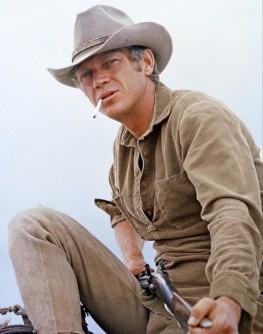
Greater Grace: A Story of God, Redemption, and Steve McQueen

I so admired McQeen as an actor. When I read this, it was so perfect!

Esther's avatarYankee Gospel Girl

Steve McQueen, Nevada Smith

[Editor’s note: I still get dozens of hits on this page daily, so if you’re a visitor, welcome! If you’d like to know a bit more about me and this site, here’s the quick version. Thanks for reading!]

********************

They said he could act with the back of his head. No dialogue or frills required—his mere presence loomed larger than life in every shot. Put him next to some of the finest actors in the business, and he would undercut every one of them simply by being in the frame. His piercingly distinctive blue eyes were set in a rough-hewn, unconventionally handsome face that rarely betrayed strong emotion. His smallest physical gesture was precisely calculated and gracefully executed. You couldn’t best him, you couldn’t buy him, you couldn’t touch him. He was the King of Cool. He was Steve McQueen.

View original post 1,818 more words

Posted in Uncategorized | Leave a comment

The Tear

31 Croft Road's avatar31 Croft Road

He had the job of getting the four of them to church, his youngest daughter and the neighbor’s two. They were all about six. Semi-controllable. Or at least controllable by a Dad “look.” However control was not necessary as the event that morning converted the children from floor surfers to complying urchins. But not Ellen.

She held center stage.

They were busy sliding on the kitchen floor in their socks; the children not the Dad. The four of them were heading to Church, his wife and eldest already having left for commitment reasons. He was on time as his coffee was still hot and had just given the “all aboard” command as the children began their final slides. Two completed their slides using the counter to brake. One did not. While hurrying her slide, Ellen’s speed had accelerated too fast and her balance was sidelined. She was not going to…

View original post 1,204 more words

Posted in Uncategorized | Leave a comment

The Last Hunt

31 Croft Road's avatar31 Croft Road

The Boys had been making the trip for close to fifty years. They had left a lot of rubber on the road.   This trip was like the others.  It took a while before they slowly engaged in any type of depth.  Reacquainting takes time.  When they were northbound, change softened tongues and thoughts. Youthful they became with weathered attitudes.  Acquired daily habits slipped off by the mile.  Their eyes narrowed and became watchful.  The day slowly darkened.

Thirty years earlier the three had joined Robert John’s Father who commanded a station wagon towing a Datsun mini truck; covered flatbed engorged with the trappings of decoys and gear.  It had been the first for Younger and the third for Smith.  Robert John was making his six or seventh since permitted to pull the trigger.   He had learned to shoot with his dad and uncle on a shallow water lake which…

View original post 3,163 more words

Posted in Uncategorized | Leave a comment

The Last Hunt

The Boys had been making the trip for close to fifty years. They had left a lot of rubber on the road.   This trip was like the others.  It took a while before they slowly engaged in any type of depth.  Reacquainting takes time.  When they were northbound, change softened tongues and thoughts. Youthful they became with weathered attitudes.  Acquired daily habits slipped off by the mile.  Their eyes narrowed and became watchful.  The day slowly darkened.

Thirty years earlier the three had joined Robert John’s Father who commanded a station wagon towing a Datsun mini truck; covered flatbed engorged with the trappings of decoys and gear.  It had been the first for Younger and the third for Smith.  Robert John was making his six or seventh since permitted to pull the trigger.   He had learned to shoot with his dad and uncle on a shallow water lake which produced panfish and ducks.  But it was the wheat fields of Saskatchewan where his fine shooting eye was developed. On this trip, they had come back with the car and truck topped with ducks, mallards mostly, and geese, the Canadian variety in majority.  All were secured with lines of rope.  Many eyes caught the moving feathered vehicle!   That trip secured the blood bond of hunting for the three.   The bond had produced a northern hunting continuum, interrupted only by”life.”  The wheat fields in their golden luster, especially as the sun rose or set, captivated.  The endless sky with occasional clouds interrupting the blue spectrum provided distilled distinction.   The majesty was not lost on them, but the necessity of “dark spots,” moving birds, was paramount.  They came to hunt, together.  The beauty framed.

Now, as the years dripped off they were not as enamored with the pull of the trigger as much as they were with finding the location of birds.  To know they could still “do it,” as location of birds was necessary for harvest.  But the need of a body count was not what it once had been.   When ducks were found, they were content to let the day write itself.   And it never failed to produce a story that profoundly affected them for that period of time. Memories were great, but it was the occasion of being there, in the moment, that evoked the feelings that were youthful in anticipation yet understanding of age.

Robert John had produced two children, Smith two, and Younger two.  No common design intended.  All now were off doing what young ones do, in pursuit of who and what they would and could be.  That period of seeking. Though a couple had taken the trip with the aged ones, early on, those were rare occurrences.  Now that they were older (if they asked) the trip was closed.  This was their trip; Robert John, Smith and Younger. Friends from childhood.

Robert John and Smith had lived by the tracks, the freight train line running east – west just behind their houses.  Working class houses, where children played in the fields spotted with trees; trees that became bases or goal lines. Imagination.  Where neighborhood “gangs” took on each other to command their streets.  The lake for hockey was four blocks north. The rivalry continued there.  The hunting was family orientated, removed from the streets.  Robert John was immersed in it.  Smith came in later. Others of the street took aim at light posts.

Younger joined the group when the winter had brought the various groups together to play ice hockey for the town, removed from the lake and daily blood to the rink by the school.   The town had grown up around two large lakes and the original town which pushed north to the next lake was referred to as the North side.  The separation of the North side to the developments south of the lakes was significant.  There was little mixing. Almost two separate towns.

It was to the west, where a small lake stunted growth that Younger lived in a push of suburbia that never gained much swagger.  It just did not have the blood lines of the town’s history and lacked the edge that the North side maintained.  Younger liked and needed the edge.  Especially for sports.  He preferred to cross the tracks.  The Ridgeway street boys took him on as one of theirs and no one said much about it.  But he was an exception.  The three became friends.

As the truck closed on the border, darkness engulfed them.  Engagingly “ribbing” as they could be, they knew not to make any mistakes with the border guards.  None.  They had to unload everything for inspection only one time, but it was hours before they were able to cross.  They chose to not let it happen again.  The sky was pitch black while the building screamed brightness.  Their tired eyes hurt.  They were grateful to be waved through after a brief declaration of transported items.  Winnipeg would be approached by early morning.

They had changed the logistics of the trip ten years earlier.  Time, family, and jobs marked a new order to continue.  The adjustments were the narrowing down of a week trip to four days and moving the destination from Saskatchewan to Manitoba, about a twelve-hour difference in travel. Though they left many fine contacts in Saskatchewan, they had made new ones that were essential to hunt the smaller farms and towns west of Winnipeg.  For housing to drop their packs and use as central control they found the Mojo Motel.  And for reference of hunt possibilities, they had run across Derek.   Derek, having lived in the area had significant connections, which enabled them, if fowl were located, to begin hunting that evening. The nature of the hunt had moved from geese to mallards, though they would “pound” any goose who came calling.   Greenly was a small town with a gas pump and shriveled downtown.  To the “boys” it mattered not. A gas station, a warm meal if possible as well as a real bed was all that were needed.  The Mojo provided the measure of softness.  The past of sleeping in a shed, three to a played out mattress was gone.  The hand digging of pits in the middle of the night were swept away with snoring sleep.  The hunt had necessarily moved to convenience, but ducks were ducks and one still had to locate them, get into a position that allowed opportunity, and then get bifocals steadied to get shots off.   Limits had ceased to matter.  It was the opportunity that took on the majesty of the hunt.  And here they had not lost their touch, learned from so many years with shotgun in hand.

Smith was the one with the binocular eyes.  His amazing ability to see “miles” in the sky and detect the flight of dots had not wavered, nor his appetite to get to the basics, kill ducks, and relish in the aftermath with a cold “pork chop” in hand.  Growing up two doors down from Robert John had brought them physically close, and their love of the hunt even closer.  Fact was Smith was benched the last three games of his junior year football season because he had gone on the annual hunt.  His discipline accepted this just as he accepted the fact that he told his coach what he was going to do. His blood pumped harder in the fields of Canada then the striped one at the high school.

Robert John was the mystic.  Yet he also had the steadiness of measured motivation to follow his heart.  He married his high school sweetheart. They managed to find firm footing when nature said marriage was right. Where Smith would be firmly on the right measure of societal norms, Robert John found himself putting a foot over the line to the left.  One could account it to his father’s union affiliation and thus upbringing, but it was more to his measure for the downtrodden, the little guy, which produced in him an affiliation of liberal accreditation.  To his personal ability, he could amazingly produce friends anywhere without pretense, as Smith could. Both were immeasurably likeable.  Their connectability was different but consistent in its sameness.  Some how the “wiring” worked wonderfully.

Younger was the add-on, or perhaps add in.  From across the tracks.  He had bipolar tendencies, but the lines did not descend to deep depression but rather from normal tendencies to activity that seemingly bounced off walls. His fondness for fun over reached responsible life unless leashed. Marriage had kept the bounces controlled.  And a sprinkling of age.  He could be articulate one moment and audibly insane the next.  But he ran with the two Ridgeway street boys through the years.  He ended up the one that was in their mix more than any other.  He too was hard to dislike.

All three could hunt, and hunt hard.   Now they had turned the corner, hit that magic number of 65 and measured downsizing.   All had faced trials, as life painted them.  Buried children, surgeries, implants, stents; They accepted and lived.  None dwelled.  Each just kept living.  And their autumn had come, just as the season of a year, quickly and un-spurious in manner.

They knew that a trip such as this was getting to be a different kind of “hard.” This was something that brought all up short.  The understood “hard.”  They embraced it.  If the success they enjoyed on the hunt had been not traipsed with hardness, they would have felt cheated.  But now they did not want that piece to be altogether there, in truth.   And with this they understood, with the early light beginning to embrace the sky and the lights of Winnipeg showing soft in the distance, they were on their last trip.  It did not have to be said.  They knew, but pretended not.   The hunt was before them.  All three were watching the thin grey sky line become clearer.

Derek had located a field with a draw holding water.  It was perhaps 300 yds out from a tree line in a wheat field.  A sweet distance for old legs. And it was only five miles from the Mojo.  “Hard” had softened a little.   As the boys pulled into the motel just past noon, he met them with the news, but not before the preliminaries.  The beer was cold!  It was here, in room 102 where the field of promise was described.  Permission had been granted.   Juices began to flow.  All began to ready for the evening hunt.

Derek had his measure of obstacles, but he kept on the hunt as it produced the adrenaline that made him want life.  And he had become more than just the casual acquaintance to the boys, especially Robert John.  Now they were together, readying up to shoot some green heads.  Their recurring pains began to ebb away and they felt the same thrill that always accompanied the hunt, especially the first shoot.  After driving many miles they were anxious to let loose.  Have the chance.  They checked gear and loaded up into Derek’s duck killing machine, an older Dodge four door pickup with ducks painted in its entirety. It was time to hunt.

The fourth morning found the four crouched low behind shrub, perhaps thirty yards from the water.  It was a field pond found scouting the day before.  That first evening had produced a nice limit of grand “red legs,” an affectionate name for the birds that came down late season; all mature, green textured necks and stark red replacing the normal orange color of legs.  Big birds.  All drakes the boys pulled out of the sky.  And the “hard” had been softened.  The next day they tried the same pond and came up empty. Scouting now prevailed and the two trucks separated  to find opportunities. Here miles were racked up as each took their time to be as precise of location, if any, and then seek to secure permission.  It was the part of the hunt that many tired of. They found pleasure.  Semi down time to engage. Robert John always jumped in with Derek on the scouts. Smith and Younger partnered up.  The mix was right.  It just took time and luck to find the places birds were using and then getting the right to hunt.  It was not automatic, nor did they expect it to be.  Over the years they had found wonderful opportunities but for some reason or another were denied.  Then there were those hunts that stood grand in the mind.

The second and third days had produced birds, but nothing like the first night.   And the places hunted were more difficult to get to by foot, especially with the frost and the wetness that prevailed with the arrival of snow.  But the snow also brought more birds. They just needed the right combinations to fall into place.  Smith saw something moving just above the horizon as the sun began setting, just over a knoll in a field west of an alfalfa field.  It was a dirt field, so he knew that if what he saw were ducks, there had to be water attracting them.   He and Younger got out the binoculars and began to train their sights on the knoll.  Soon, Smith before Younger, both saw what they hoped, ducks dipping down low across the field and being lost from sight. The did not emerge on the other side.  The light was diminishing more. Smith knew they did not have much time, so he began moving as quickly as he could to the side road near the field.   As he drove, more and more ducks began to plummet to the far side of the hump.  They knew that there was water.  They marked the location by memory and headed off to gain permission.

Derek and York had gone out fifteen miles, crisscrossing the matrix of farms. The found groundwater and slew, but nothing which indicated shootable populations, just small flocks shifting about on the waters.  As darkness settled  they got the call from Younger that he and Smith had found ducks and gained permission.  They agreed to meet at the Mojo.

Though they did not have a full limit for all of them combined, they had ducks and a few geese in hand.  A nice little shoot would fill tags.  As they warmed themselves in the motel and choked down sardines with crackers chased with beer, they were gratified that the first hunt had been successful. The following two days found the quest fulfilling.  The grind they exposed themselves to with limited results dampened not the hunt. But they did hope to get one more shoot in.  Tomorrow morning would be the last opportunity.

A serene melancholy seemed to seep into the room.  Tiredness combined with beer and anchored to reality made the room one which took on greater meaning.  Though nothing was said, there was a calm realization that the next morning would be special, no matter what prevailed.

Daylight came late, as the wind whipped snow blocked sight.  Slowly, laying just behind the knoll, the boys began to get their morning eyes. It was at that moment that they heard the “swish” flit by, followed by a “swoosh.”  Wings, in the air.  Lots of wings.  Smith checked his watch. Five minutes.  He now could see the birds, coming in small but steady flights.  Rockets of feathers, cupped wings out front.  When he said ready, all four pushed up to kneeling level.  At the appointed time they commenced to fill the sky with steel.

It was over in an hour, maybe less.  The mallards had come straight into the pond as if on a string.  The boys only stayed an extra hour to see if by chance some geese might want in on the “fun.”  None came.  It was time to go. Finding their ducks was a little harder this year as the last of the dogs had died two years earlier.  But they found all but one.  They had secured their limits.  When they reached the trucks, Robert John did what he had done every year.  He placed the ducks on the ground in military fashion and brought out the ones packed in the back of the truck. They were not as handsome in death as in life, but the striking colors did justice to the “take.” Small smiles looked down on the harvest. It was a good indeed.

It wasn’t a fashionable goodbye, just the usual pictures, handshakes with man hugs and the packing of gear.  Perhaps the weather played a part in the departure being so narrow focused.  Or that no one wanted to linger with the thought of being “done.”  It mattered not.  They knew and respected the hunt and each other.  Derek got in the duck truck and waved a salute out the window.  The other three stuck gloved hands skyward and held for just a fraction longer.  The three friends packed the truck as the snow began to come harder.  They looked out at the field and saw flocks of Canadian geese cupping wings and dropping from the heavens toward the pond.  They looked at each other and laughed.  Quickly packing the truck, Smith took the wheel with Robert John slipped in by his side. Younger sat upright in the back and watched the geese.  They headed East.

The Canadian trip did end that year.  Derek was killed in a truck accident when some hopped up teenagers caught him broadside on a gravelled Saskatchewan road.  He died instantly.  Robert John and Smith made the funeral.  Robert John brought a framed picture of the last hunt, the one taken in the snow.  It was placed on the wooden coffin by Derek’s wife.

Smith battled cancer for another ten years and finally succumbed to the big C when he rejected the planned treatments.  He chose to travel the world, a dream that he had always entertained.  It turned into a great adventure.  He came home after ten months to his home where, surrounded by his family he left.  By the bed was the last hunt picture.

Robert John retired the next year and he and his wife moved to Florida.  He took up sea fishing and because of an off-chance of meeting one of the best guides in the Sarasota region, he took his fresh water skills and caught many redfish, trout, and grouper in the bays and inlets.  He died of a heart attack while resting in between fishing outings.   He came home to be buried with family.  His son placed the last hunt picture in the casket just before they closed it to begin the ceremony.

And Younger pushed them all in the ground, but he never knew it, excepting Derek.  Younger began to show signs of dementia when he turned 67 and it progressed rapidly. Smith saw him as often as he could before he died. Robert John saw him when he and his wife came up in the Spring to spend time with family.  Younger hung on and passed when he was 93.  He outlived them all, but could not do them honor.  Or if  he did, it was not pronounced. Once, an aid thought heard him say “shoot.”  Another time “get down.”  But the utterance was muddled so it could not said for certain. They found him one day in bed, his mouth open and a crumpled picture in his hand.  The last hunt.

The last picture taken, wind swirling with snow and the boys kneeling just behind a limit of “red legs.”  It had been favorable and quietly compassionate. This they had known.  And the treasure was marked in years; together in the Provinces of Canada; big sky, panoramic scenes and ducks. They had been blessed.

Posted in Uncategorized | Leave a comment